
Your Life Doesn't Have to Wait.
290
Average days waiting for a publicly funded long-term care bed in BC
BC Seniors' Advocate Report, 2024 — cited by multiple health authorities as current for 2026
If you've recently looked into senior care in British Columbia, you've likely stumbled across a number that stops you cold: 290 days. That's the current provincial average wait for a publicly funded long-term care bed — nearly ten months. In high-demand areas like Victoria, Kelowna, and parts of Vancouver, the wait can stretch anywhere from 18 months to two years.
For many families, that number feels like a countdown. Like real life is being paused until a bed opens up.
It isn't. And it doesn't have to feel that way.
Whether you're a senior who fiercely values your independence, or an adult child lying awake worrying about your parent, here is how families across BC are not just surviving the Care Gap — they're thriving through it.
For the Senior: Keep Your Freedom. Delegate the Drain.
You love your home. Your neighbourhood. The way the light falls in your kitchen in the morning. You're not looking for "nursing care." You just notice that the grocery run now wipes you out for the rest of the day, or that your phone seems to update itself into something unrecognizable every few months.
You're not losing independence by asking for help. You're protecting it.
Every hour you spend wrestling with a technology problem or hauling laundry is energy you're not spending on the things that actually make your life yours — your garden, your grandchildren, your book club. A Lifestyle Assistant handles the logistics of daily life so you can focus on living it.
Private in-home services are also remarkably flexible. You might only need a few hours a week right now. But if your needs change, those same services can scale all the way up to 24-hour support — letting you stay in your own home longer than you might have thought possible, without any emergency moves or rushed decisions.
For the Adult Child: Stop Being the Worrier. Start Being the Son or Daughter Again.
You know the feeling. Your phone buzzes and your stomach drops for half a second before you check it. You're trying to be present at your kid's recital, but part of your mind is three blocks from your parent's house, running through scenarios.
This is Caregiver Burnout — and it's far more common than anyone talks about.
The guilt doesn't go away because you're doing more. It goes away because you're doing the right things.
What most families discover after hiring a professional companion: phone calls become real visits again, not wellness checks. Dinners together stop feeling like inspections.
A professional caregiver also does something a daily phone call simply cannot — they're physically present. They notice the shuffle that's getting a little worse, the fridge that hasn't been opened, the mood that's been low for a week. They catch the warning signs that prevent the crisis: the fall, the emergency admission, the agonizing last-minute decisions.
And if your parent needs round-the-clock supervision? Private services can provide 24-hour care in the comfort of their own home while they remain on the public waitlist. No uprooting. No emergency move. Continuity and safety, on their terms.
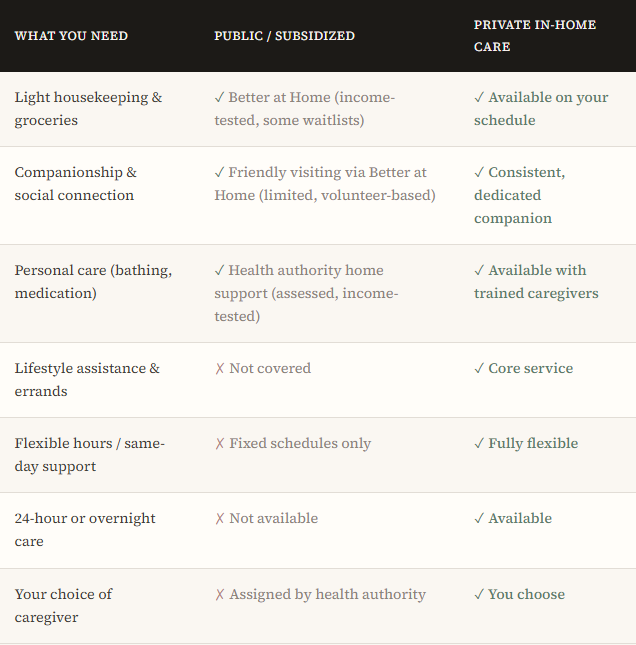
Public Support vs. Private Care: What Each Can Do
There are genuine government programs that help seniors stay at home — and it's worth knowing what they cover so you're not disappointed later.
Your Life is Happening Now
The waitlist is real. The wait is long. But the time between now and a placement doesn't have to be a period of anxiety and held breath. It can be a period of living well — with the right people alongside you.
Whether you're a senior looking for a Lifestyle Assistant, or a family who needs a professional Safety Net, we're here for that conversation.
Ready to bridge the gap? Click “FREE IN HOME CONSULTATION” or call (250) 516-8947 for a free, no-pressure chat about your needs.
