
Can Seniors Get Government Help to Pay for In-Home Support?
Many seniors want to remain safely and independently in their own homes. However, the cost of personal care, meal preparation, housekeeping and other daily assistance can be difficult for families to manage.
Government-funded or subsidized support may be available, but there is no single grant that allows every senior in British Columbia to hire any private caregiver. Eligibility depends on the senior’s health, assessed care needs and personal circumstances.
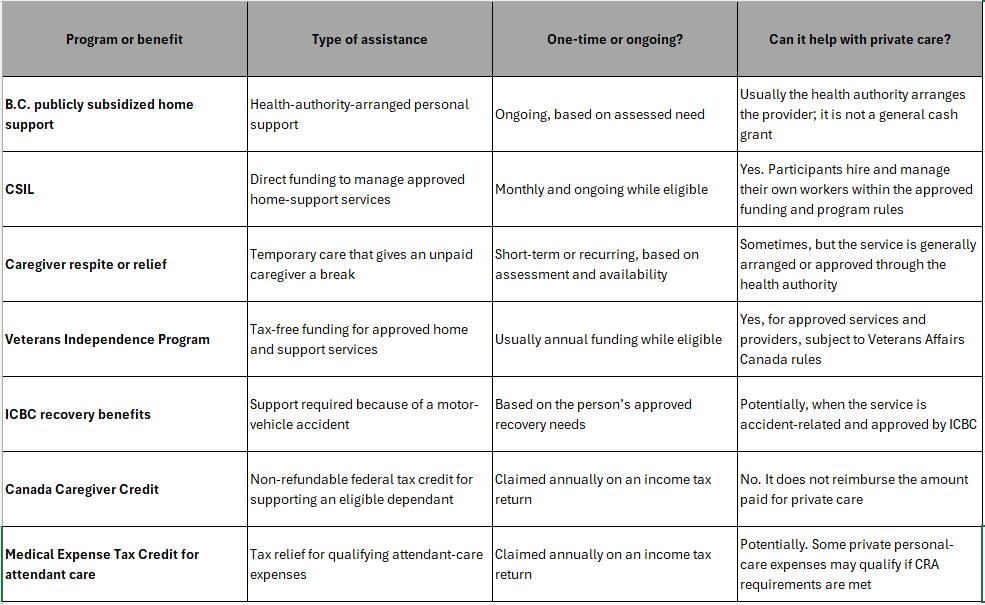
Publicly Subsidized Home Support in B.C.
Eligible B.C. residents may receive subsidized home-support services through their regional health authority.
These services help people who need personal assistance with activities of daily living, such as bathing, dressing, mobility and toileting. A health authority professional assesses the person’s needs and determines which services may be approved.
Depending on the person’s circumstances, a client contribution may be required. In most cases, the health authority arranges the service. It is not normally a cash grant that can be used to hire any private care company.
Choice in Supports for Independent Living
Choice in Supports for Independent Living, commonly called CSIL, is a self-directed home-support option for eligible people who require ongoing personal assistance.
Approved participants receive a set amount of funding each month from their health authority. The amount is based on the number of home-support hours identified through a clinical assessment and the applicable CSIL hourly rate.
The participant becomes responsible for hiring, scheduling, supervising and paying their support workers. CSIL is therefore ongoing monthly funding—not a one-time grant.
Caregiver Respite and Relief
Family members and friends often provide a large amount of unpaid care. Respite services give caregivers a temporary break from the physical and emotional demands of caring for another person.
Respite may be provided:
in the senior’s home;
through an adult day program; or
through a temporary stay in a care facility.
Access normally requires an assessment through the regional health authority. The type and amount of respite available depend on the senior’s needs, the caregiver’s circumstances and local service availability.
Veterans Independence Program
Eligible veterans may receive assistance through the Veterans Independence Program, commonly called VIP.
The program provides annual tax-free funding for approved services that may include personal care, housekeeping, meal preparation, transportation, grounds maintenance and certain professional health and support services.
Eligibility and approved services are determined by Veterans Affairs Canada.
Assistance Following a Motor-Vehicle Accident
A person who requires personal care or homemaking assistance because of injuries from a motor-vehicle accident may qualify for recovery-related benefits through ICBC.
This is not a general senior-care program. The services must be connected to the accident and approved as part of the individual’s ICBC claim.
Tax Credits and Medical Expenses
Tax benefits are different from grants or subsidized services. They generally reduce the income tax a person owes rather than providing money in advance to hire care.
The Canada Caregiver Credit may be available to someone who supports a spouse, partner or eligible dependant with a physical or mental impairment. It is not based on the amount paid to hire a caregiver and does not directly reimburse private-care costs.
However, some payments for private attendant care may qualify separately as eligible medical expenses. The rules depend on the person receiving care, the nature of the impairment, the services provided and the required medical documentation.
Families should keep detailed receipts and confirm eligibility with the Canada Revenue Agency or a qualified tax professional.
How to Get Started
Seniors and families interested in subsidized home support, CSIL or caregiver respite can contact the Home and Community Care office of their regional health authority and request an assessment.
Veterans can contact Veterans Affairs Canada. Anyone seeking support after a motor-vehicle accident should contact their ICBC recovery specialist.
How Where You Belong Can Support You
Understanding the differences between grants, subsidized services, direct funding and tax credits can feel overwhelming.
Where You Belong provides friendly companionship and general information to help seniors and families understand available support programs and where to obtain official information.
Where You Belong does not determine eligibility, complete applications or provide legal, medical, tax or financial advice. Eligibility and funding decisions are made by the responsible government agency or organization.
